
Ashwagandha and Coffee: Is It Safe to Take Together?
For most healthy adults, taking ashwagandha and drinking coffee on the same day is not known to cause a problem. The NIH fact sheet on ashwagandha does not mention caffeine at all, and there is no solid evidence that ashwagandha cancels caffeine jitters. The real cautions are about ashwagandha itself: rare liver injury reports, thyroid effects, pregnancy, and several medications. Ask a health care provider first if any of those apply.
- Trial doses
- 240–1,250 mg extract per day, stress trials (NIH)
- Typical trial length
- 6–8 weeks 2021 review of 7 trials (NIH)
- Safe-use window
- Up to ~3 months long-term safety unknown (NIH)
- Caffeine limit
- ~400 mg a day most adults (FDA)
Start with your question
These are the questions people ask when they search for this, answered with what the NIH and NCCIH actually say.
Can I mix ashwagandha with coffee?
Can I drink coffee after taking ashwagandha?
Does ashwagandha cancel out caffeine, or calm the jitters?
Can I put ashwagandha powder in my coffee?
I take it for sleep. Should I skip the afternoon coffee?
What the evidence says
Ashwagandha has real research behind it, and real cautions. Caffeine is mostly absent from that research.
Stress and anxiety. The NIH fact sheet describes a 2021 systematic review of 7 trials in 491 adults, all in India, lasting 6 to 8 weeks. Ashwagandha reduced stress, anxiety, sleeplessness, fatigue and cortisol compared with placebo, with larger effects at 500 to 600 mg a day. Later trials were mostly small, and one 12-week trial in overweight adults found no reduction in perceived stress.
Sleep. A 2021 meta-analysis of 5 studies (372 adults) found a small but significant improvement versus placebo, greater at 600 mg a day and with at least 8 weeks of use.
The NCCIH view is more cautious: ashwagandha is "possibly helpful" for some people with insomnia and stress, evidence on anxiety is inconsistent, and many studies are small and use different preparations (NCCIH).
Which sounds like you?
Pick the one that sounds like you and we will point you to a coffee that fits.
Coffee makes me jittery
You want the ritual without the shakes, whatever else you take.
- Time
- 5 to 10 minutes
- Effort
- Low
- Caffeine
- Decaf is about 1 mg per 8 oz; half-caf splits it
- Should feel
- Mellow, no sharp edges
Decaf figure is the Mayo Clinic average for brewed decaf; our label has the serving details.
A smooth daily cup
You want an easy, comforting coffee for your regular routine.
- Time
- 5 to 10 minutes
- Effort
- Low
- Caffeine
- About 96 mg per 8 oz brewed
- Should feel
- A familiar lift
Caffeine figure is the Mayo Clinic average for brewed coffee.
Fast and simple, anywhere
You take supplements in the morning and want coffee in about a minute.
- Time
- About 1 minute
- Effort
- Almost none
- Caffeine
- About 62 mg per 8 oz (instant)
- Should feel
- Smooth and quick
Caffeine figure is the Mayo Clinic average for instant coffee.
Safety at a glance
Ashwagandha is a supplement with cautions. Here is what the NIH and NCCIH list, in one place.
| Topic | What the sources say |
|---|---|
| How long | Well tolerated for up to about 3 months; long-term safety (months to years) is unknown. |
| Common side effects | Mild: stomach upset, loose stools, nausea, drowsiness. |
| Liver | Rare case reports of acute liver injury, sometimes in people with existing liver disease. |
| Thyroid | Can change thyroid hormone levels; case reports of thyrotoxicosis. People with thyroid disorders should avoid it unless a provider says otherwise. |
| Pregnancy and breastfeeding | NCCIH says to avoid. Some regulators have advised against use in certain groups. |
| Medications | Possible interactions with diabetes, blood pressure, thyroid hormone, immunosuppressant, sedative and anti-seizure medicines. |
| Other | May raise testosterone (caution with hormone-sensitive prostate cancer); NCCIH lists people scheduled for surgery and those with autoimmune disorders among those who should avoid it. |
From the NIH Office of Dietary Supplements and NCCIH. Supplements are not FDA-approved before sale, so product contents vary. Choose a product that lists its extract strength, and talk to your provider before starting.
What does a Moodwell cup cost?
A 12 oz (340 g) bag makes about 17 cups at 20 g per cup, so each bag below shows its cost per cup. Instant is priced per bag.
Next: caffeine and timing ↓Caffeine and timing
Whatever you take with it, keep an eye on the coffee side.
- How much. The FDA cites about 400 mg of caffeine a day, roughly two to three cups of coffee, as an amount not generally associated with negative effects for most adults.
- Typical cups. The Mayo Clinic lists about 96 mg in 8 oz of brewed coffee, 62 mg instant, and about 1 mg decaf.
- Timing. Caffeine's half-life is about four to six hours (UPMC), so afternoon cups can affect sleep.
- Jittery or anxious. A smaller cup, food, or half-caf is the simplest fix. Ashwagandha is not a guaranteed fix.
Moodwell picks
Three coffees for the three kinds of people above. None contain ashwagandha.
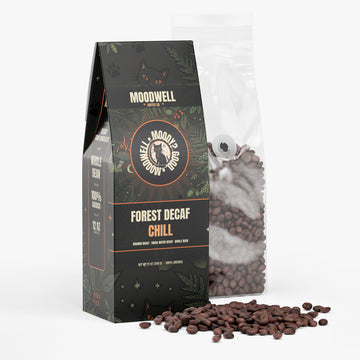
For a gentle cup or a late one.
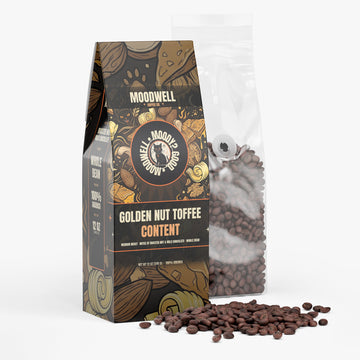
An easy flavor-first everyday coffee.
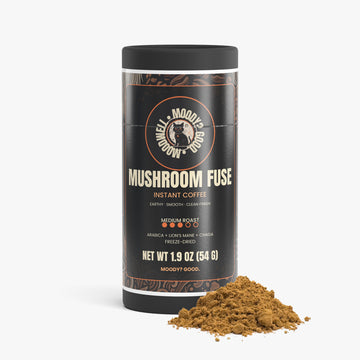
Instant, with Lion's Mane and Chaga.
Not sure? Take the mood quiz or see all coffees.
Talk to a provider
Check with a health care provider before combining supplements and coffee if any of these apply.
- You are pregnant, trying to conceive or breastfeeding.
- You have thyroid, liver or autoimmune conditions, or hormone-sensitive prostate cancer.
- You take diabetes, blood pressure, thyroid, immunosuppressant, sedative or anti-seizure medicine.
- You have surgery scheduled.
- You are taking it for anxiety or sleep problems that are affecting your life.
This page is general information, not medical advice. Moodwell does not sell ashwagandha.
Questions
Can you take ashwagandha with coffee?
For most healthy adults there is no documented problem, but the NIH fact sheet does not discuss caffeine, so the evidence on the combination is thin. The more important cautions are about ashwagandha itself: liver, thyroid, pregnancy and medication interactions.
Can I drink coffee after taking ashwagandha?
Nothing in the NIH or NCCIH material we reviewed says you cannot. If your stomach is upset, which both can cause, try them at different times or with food.
Does ashwagandha cancel out caffeine?
We found no solid evidence that it does. Trials studied stress, anxiety and sleep, not caffeine effects.
Does ashwagandha reduce caffeine jitters?
Not established. If coffee makes you jittery, a smaller cup, food, or half-caf are simpler fixes.
How much ashwagandha is used in studies?
The NIH reports stress and anxiety trials using 240 to 1,250 mg a day of extract, with larger effects at 500 to 600 mg in one review, and sleep trials using 120 to 600 mg a day.
How long can you take ashwagandha?
The NIH says it is well tolerated for up to about 3 months, and that long-term safety is unknown.
Is ashwagandha safe for your liver?
There are rare case reports of acute liver injury linked to ashwagandha products, sometimes in people with existing liver disease. Talk to a provider if you have liver problems.
Who should not take ashwagandha?
NCCIH says to avoid it during pregnancy and breastfeeding, and lists people scheduled for surgery and those with autoimmune or thyroid disorders or hormone-sensitive prostate cancer. It may interact with several medications.
Does coffee affect sleep if I take ashwagandha for sleep?
Caffeine has a half-life of about four to six hours, so a late cup can affect sleep on its own. Moving your last coffee earlier is a good first step.
Does Moodwell coffee contain ashwagandha?
No. Moodwell does not sell ashwagandha, and Vitality and Mushroom Fuse contain only coffee, Lion's Mane and Chaga.
Sources
- Ashwagandha fact sheet for health professionals – NIH Office of Dietary Supplements: evidence, doses and safety
- Ashwagandha – NCCIH: what research shows, who should avoid it, interactions
- Caffeine content – Mayo Clinic: caffeine per cup
- Spilling the beans: how much caffeine is too much? – FDA: 400 mg a day
- Matcha vs. coffee – UPMC HealthBeat: caffeine half-life
This page is general information, not medical advice. Cost per cup is our calculation at 20 g per cup. Moodwell sells coffee, not ashwagandha.
Keep reading: Mushroom coffee vs matcha · Best mushroom coffee for focus · Mood quiz · Wake-up coffee guide