
Does Coffee Raise Cortisol? What the Studies Show
Caffeine can raise cortisol in the short term, and one review abstract reports about a 50% rise from coffee. But regular drinkers may respond less, one 2024 stress study found the opposite pattern, and there is no scientific proof of a single best time to drink coffee. Waiting 90 minutes is optional, not required.
- Review of 15 studies
- ~50% rise coffee vs baseline (abstract)
- Regular drinkers
- Mixed weaker or stronger by study
- Cortisol peak
- 7–8 a.m. typical (Cleveland Clinic)
- Best time to drink
- No proof Cleveland Clinic
Start with your question
People ask this a few ways. Here are plain answers from the sources we read.
Does coffee raise cortisol?
Does it matter if I drink coffee every day?
Should I wait 90 minutes after waking?
Does mushroom coffee lower cortisol?
Why does coffee make me jittery or anxious?
What the studies actually found
Three sources, three different kinds of evidence, none of them settles it.
| Source | Who and how | What it found |
|---|---|---|
| Comparative review, conference abstract | 15 studies, 2000–2024; about 2,500 people across 10 coffee studies | Coffee about 50% above baseline, other caffeinated drinks about 30%, tea about 20%. Habitual users showed weaker responses. No statistics or methods are given (Endocrine Abstracts). |
| Stress-speech study, Psychosomatic Medicine (2024) | College students giving a pressured public speech | Regular caffeine users had higher cortisol reactivity than expected. The authors call it preliminary, and the page does not report the sample size (UNCG). |
| Duke trial, Psychosomatic Medicine (2002) | 47 habitual coffee drinkers; 250 mg caffeine twice in a day vs placebo, double-blind | Higher blood pressure through the day and night and adrenaline up 32%. The release refers to stress hormones in urine and does not name cortisol, and the effects were short-term (Duke Health). |
None of these tested mushroom coffee, and none shows that coffee harms or helps cortisol in the long run.
Which sounds like you?
Pick the line that sounds like you.
Coffee makes me jittery
You like the ritual but feel wired or anxious.
- Time
- 5 to 10 minutes
- Effort
- Low
- Caffeine
- About 1 mg per 8 oz decaf; half-caf splits it
- Should feel
- Mellow, no sharp edges
Wait a bit after waking or eat first, and see how you feel.
I feel fine, I just heard I should wait
Coffee agrees with you and you are wondering if timing matters.
- Time
- As usual
- Effort
- None
- Caffeine
- About 96 mg per 8 oz (brewed average)
- Should feel
- Your normal lift
Earlier in the day is easier on sleep.
I want it quick and small
You want a smaller cup without a brewer.
- Time
- About 1 minute
- Effort
- Almost none
- Caffeine
- Instant averages about 62 mg per 8 oz
- Should feel
- Lighter body
Instant averages less caffeine per cup than brewed.
What to try
If you want to experiment, here is a simple way to do it.
| If this is you | Try this | Why |
|---|---|---|
| Jittery or anxious after the first cup | Smaller cup, with food, or half-caf; or wait 30 to 60 minutes | Sensitivity varies by person (Cleveland Clinic; A Healthier Michigan) |
| Feel fine on your usual cup | Keep it | No scientific proof of a single best time (Cleveland Clinic) |
| Sleep is poor | Move your last cup earlier | Caffeine lingers for hours; see our caffeine guide |
These are our suggestions based on the sources above, not a clinical protocol.
What does a cup cost?
A 12 oz (340 g) bag makes about 17 cups at 20 g per cup, so each bag below shows its real cost per cup. Orders of $40 or more ship free in the United States.
Next: keep your total in view ↓Keep your total in view
Keep your total in view.
- The FDA cites about 400 mg a day, roughly two to three 12 oz cups, as an amount not generally associated with negative effects for most adults. Pregnant or nursing people should ask a provider.
- Averages per 8 oz: brewed about 96 mg, instant about 62 mg, decaf about 1 mg (Mayo Clinic).
- Caffeine and sleep: see caffeine and timing.
Moodwell picks
Three ways to adjust your cup, with what each costs.
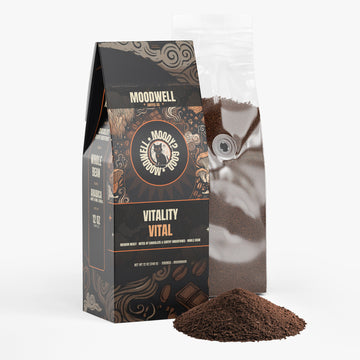
Ground medium roast with a small mushroom blend. Low acidity.
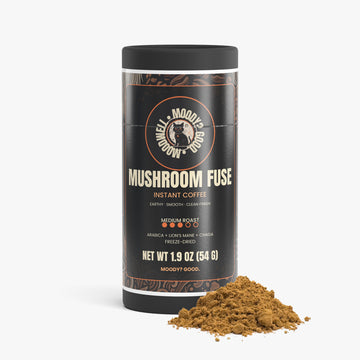
Instant with a higher mushroom share.
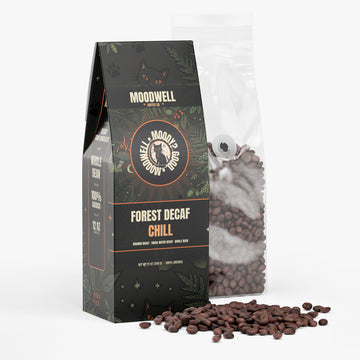
A gentler, low-caffeine option.
Not sure which? Take the mood quiz or see all coffees.
Talk to a provider
Ask a provider about caffeine if you have anxiety, a heart condition, high blood pressure or sleep problems, or are pregnant.
A review in News-Medical notes that medicinal mushrooms can cause allergic reactions or stomach upset in some people and may interact with blood thinners, immunosuppressants and drugs for low blood sugar. Alzheimer's Drug Discovery Foundation adds that small trials of lion's mane reported nausea, stomach discomfort or skin rash in some people, and that supplement safety data is limited. If you are pregnant or nursing, take medication, have a medical condition or a mushroom allergy, check with your health care provider before trying mushroom coffee.
This page is general information, not medical advice.
Questions
Does coffee raise cortisol?
Often, in the short term. A review abstract of 15 studies reported about a 50% rise from coffee, though it gives no statistics, and results vary between people and studies.
Does caffeine increase cortisol in regular coffee drinkers?
Results are mixed. One abstract says habitual users show weaker responses; a 2024 stress study found regular users had higher cortisol reactivity than expected.
Should I wait 90 minutes before drinking coffee?
The evidence is weak. Cleveland Clinic says there is no scientific evidence for a single best time. If coffee makes you jittery, try waiting or eating first.
When does cortisol peak in the morning?
Typically around 7 to 8 a.m., according to Cleveland Clinic.
Does tea raise cortisol less than coffee?
The same review abstract reported about 20% for tea versus about 50% for coffee, but it gives no statistics or methods.
Does mushroom coffee lower cortisol?
We make no such claim and did not find a human trial of mushroom coffee on cortisol. It is coffee, so it has caffeine.
Does decaf raise cortisol?
We did not find a source on decaf and cortisol, so we do not make a claim. Decaf has about 1 mg of caffeine per 8 oz on average.
Why does coffee make me anxious?
Caffeine is a stimulant and sensitivity varies by person. A smaller cup, a cup with food or half-caf can help. Ask a provider if you have anxiety.
How much coffee is too much?
The FDA cites about 400 mg of caffeine a day, roughly two to three 12 oz cups, as generally not associated with negative effects for most adults.
Does Moodwell make health claims?
No. We sell coffee that tastes good and make no health claims.
Sources
- Coffee, tea and cortisol review – Endocrine Abstracts: 15-study comparison
- Habitual coffee drinkers and cortisol – UNCG: 2024 stress-speech study
- Caffeine's effects are long-lasting and compound stress – Duke Health: 2002 double-blind trial
- Best time to drink coffee – Cleveland Clinic: cortisol timing and the lack of evidence for a best time
- Why wait before your morning coffee – A Healthier Michigan: the delay-your-coffee idea
- Caffeine content – Mayo Clinic: caffeine per cup
- How Much Caffeine Is Too Much? – FDA: 400 mg a day
This page is general information, not medical advice. Moodwell makes no health claims about its coffees. Cost per cup is our calculation at 20 g of coffee per cup.
Keep reading: Caffeine in mushroom coffee · How long it takes to work · Ashwagandha and coffee · All guides