Swiss Water Decaf Explained: How It Works and How It Tastes
Swiss Water decaf removes caffeine with water, not chemical solvents. How the process works, how much caffeine is left, and how to brew it.
Short answer: Swiss Water decaf is coffee that has had its caffeine removed with water instead of chemical solvents. It keeps more of the bean's flavor than harsher methods, and it is not completely caffeine-free.
By Nazir Mahmood, Moodwell founder. Updated Nov 5, 2026.
How the Swiss Water Process works
The process starts with green, unroasted coffee and uses only water, temperature and time.
- Hydrate. Green beans are cleaned, then soaked so they swell and release their caffeine.
- Draw out the caffeine. The beans meet Green Coffee Extract, a water-based solution that already holds coffee's flavor compounds but no caffeine. Caffeine moves out of the beans into the solution, and the flavor stays in the beans.
- Dry. The beans are dried gently with high airflow and low heat.
- Filter and reuse. The caffeine-rich solution runs through carbon filters that trap the caffeine, and the clean solution is used again on the next batch.
Swiss Water describes the process as 100% chemical-free. Because it works on green coffee, the beans are roasted afterward like any other coffee.
Swiss Water vs other decaf methods
Other methods remove caffeine with solvents such as methylene chloride or ethyl acetate. Those are permitted for food use, and plenty of good decaf is made that way. The reason people look for the Swiss Water name is simple: it is the method that uses no solvents at all.
How much caffeine is left in decaf?
Swiss Water guarantees its decaffeinated green coffee is 99.9% caffeine-free. In the cup, decaf typically has about 3 to 15 mg of caffeine, based on a 2006 University of Florida study that Swiss Water cites. That is roughly 10% of a regular cup. Roast, serving size and brew method change the number, so decaf is low in caffeine, not zero.
Does decaf taste worse?
Decaf has a reputation for tasting flat, and rough processing is a big reason. A gentle water-based process keeps more of what the bean tasted like to begin with. Origin and roast then do the rest.
Our Swiss Water decaf: Forest Decaf
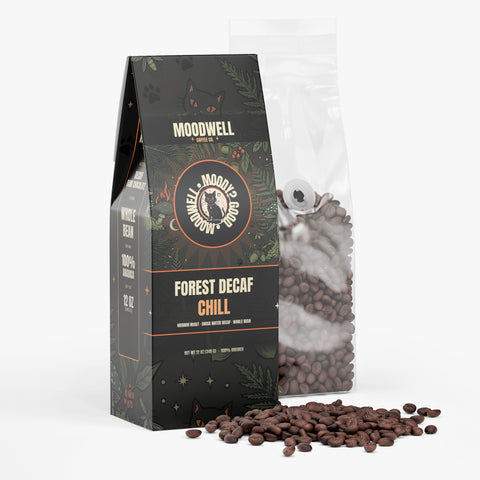
Forest Decaf is a single-origin medium roast from Sulawesi, Indonesia (Java Toraja). It is 100% Arabica, with dark chocolate flavor, earthy richness, subtle herbal depth and low acidity, in a 12 oz bag. It is our only decaf and our most chocolatey medium roast. See all of our decaf coffee. Curious how a single-origin Indonesian coffee ends up with this flavor profile? Our guide on where coffee comes from breaks down how growing region and altitude shape taste.
How to brew decaf
- Use the same ratio and water temperature you would for regular coffee: about 1 part coffee to 16 parts water, with water just off the boil.
- Drip, French press and pour-over all work well with a medium roast.
- Decaf cold brew: grind coarse, steep 12 to 18 hours in the fridge, then strain. Our cold brew and iced coffee guide has ratios and recipes, and cold brew flavors has ideas for what to add.
- Grind just before brewing and store the bag sealed in a cool, dark place. See how to store coffee beans.
Frequently asked questions
Is Swiss Water decaf really chemical-free?
The Swiss Water Process removes caffeine with water, temperature and time, with no chemical solvents. Swiss Water describes its process as 100% chemical-free.
Does Swiss Water decaf have any caffeine?
A little. Swiss Water guarantees its decaffeinated green coffee is 99.9% caffeine-free. A brewed cup of decaf typically has about 3 to 15 mg of caffeine, compared with roughly 10 times that in a regular cup.
Does decaf coffee taste worse?
It can when the caffeine is removed harshly. A gentle water-based method keeps more of the bean's flavor, and a good origin and roast matter just as much.
Can I make cold brew with decaf?
Yes. Decaf works in cold brew the same way as regular coffee. Use a coarse grind and steep it 12 to 18 hours.
Is Forest Decaf a medium roast?
Yes. Forest Decaf is a medium roast whole bean from Sulawesi, Indonesia (Java Toraja), with dark chocolate, earthy richness and low acidity.
Decaf is for the evenings when you want the ritual without the buzz. Browse the medium roasts or take the mood quiz to find your cup.