
Decaf Coffee
Decaf for the evenings when you want the ritual without the buzz. Our decaf is decaffeinated with the Swiss Water Process, which removes caffeine with water instead of chemical solvents, so more of the coffee's own flavor stays in the bean.
What is Swiss Water decaf?
The Swiss Water Process starts with green, unroasted coffee. The beans are soaked in a water-based solution that already holds coffee's flavor compounds but no caffeine, so the caffeine moves out and the flavor stays. The caffeine is then trapped in carbon filters, and the clean solution is reused on the next batch. Swiss Water describes the process as 100% chemical-free and guarantees its decaffeinated green coffee is 99.9% caffeine-free. Decaf is low in caffeine, not zero. Read the full story in Swiss Water decaf explained.
Our decaf
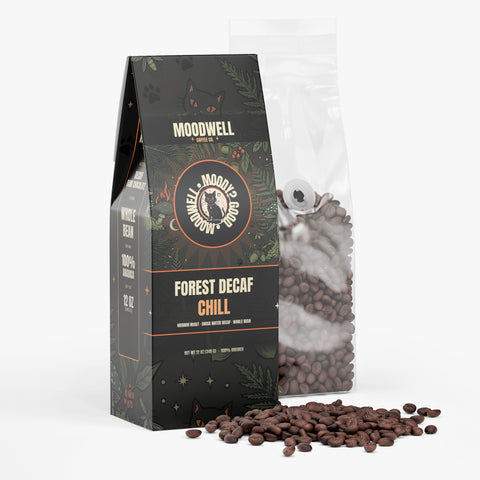
Forest Decaf is a single-origin medium roast from Sulawesi, Indonesia (Java Toraja). It is 100% Arabica, with dark chocolate flavor, earthy richness, subtle herbal depth and low acidity. It has a naturally full body, and it works in drip, French press, pour-over and cold brew.
How to brew decaf
Brew decaf the way you would brew regular coffee: about 1 part coffee to 16 parts water, with water just off the boil, and a grind that suits your brewer. For decaf cold brew, grind coarse, steep 12 to 18 hours in the fridge and strain. Our cold brew and iced coffee guide has ratios and recipes, and our brewing guide covers every method.
Decaf questions
Is decaf coffee caffeine-free?
No. A brewed cup of decaf typically has about 3 to 15 mg of caffeine, compared with roughly ten times that in a regular cup.
Does decaf taste worse?
It can when the caffeine is removed harshly. A gentle water-based method keeps more of the bean's flavor, and a good origin and roast matter just as much.
Want something with more kick?
Browse our medium roasts or dark roasts, or take the mood quiz to find your cup.
Our decaf is made with the Swiss Water Process, which removes caffeine using water instead of chemical solvents, so more of the coffee's own flavor stays in the bean. It brews like any other coffee and is meant for evenings.
How to choose
- Choose decaf for the evening ritual without the buzz.
- Brew it hot, or as cold brew for a late-night glass.
- Swiss Water decaf is decaffeinated with water, not chemical solvents.
- Decaf still contains a small amount of caffeine.
Questions
How is Moodwell decaf made?
It is decaffeinated with the Swiss Water Process, which uses water rather than chemical solvents to remove caffeine.
Does decaf have any caffeine?
Decaf contains a small amount of caffeine, far less than regular coffee, but it is not completely caffeine free.
Can I make cold brew with decaf?
Yes. Use a coarse grind and steep for 12 to 18 hours in the fridge, just like regular cold brew.
What does Moodwell decaf taste like?
See the product page for current tasting notes. Read our Swiss Water decaf guide to learn how the process affects flavor.
Shop by flavor: Chocolate & dessert · Fruity & bright · Nutty & caramel · Smooth & low-acid · Bold & strong
Keep reading: Mood quiz · Light vs medium vs dark roast · Brew whole bean at home · Cold brew and iced coffee · Milk brew · Swiss Water decaf · What tasting notes mean